







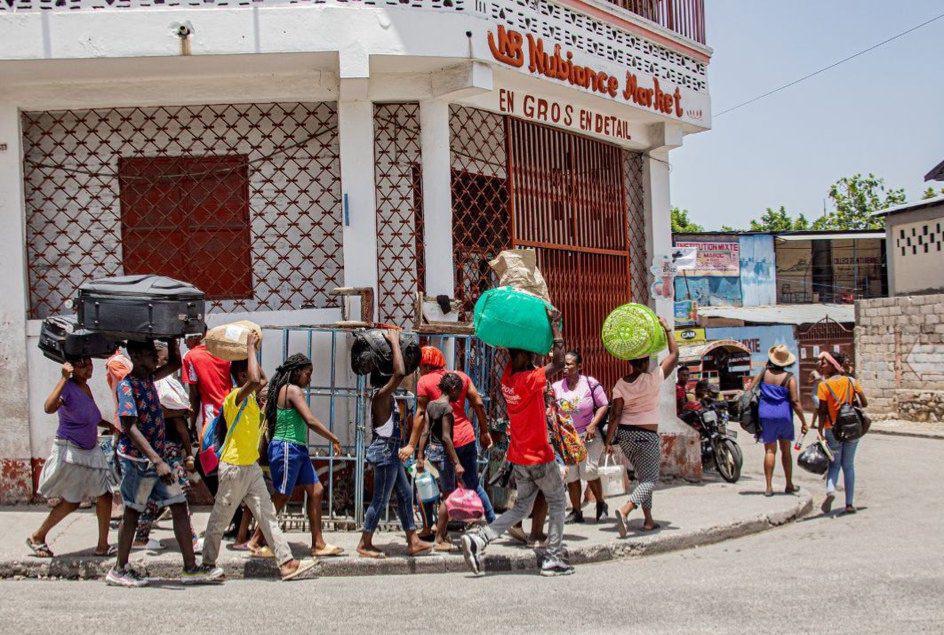




Port-au-Prince, September 8, 2025.- While the Organization of American States (OAS) is advancing a roadmap estimated at USD 2.6 billion for « restoring peace » In Haiti, the ground sends a completely different echo: gangs call the inhabitants of Solino, Delmas 2, Delmas 30 and the Lower part of the city to return to their homes, while the government and the PNH prohibit, invoking the intensification of operations in areas occupied by Viv Ansanm. Displaced students, professionals and neighbourhood actors interviewed denounce a deadly trap for civilians, a broken confidence in international promises and a clear consensus on the issue at hand: without security, no credible elections or social revival are possible.
One « road map » ambitious, burning ground
In a context of a security and humanitarian crisis that is worsening daily, the Multinational Security Support Mission (MSS) is still slow to effectively support the Haitian National Police (HNP). Against the background of slippery deadlines for the constitutional referendum and elections provided for in the Agreement of 3 April 2024, the OAS proposed a road map based on five priorities and estimated at 2.6 billion US dollars. But local reality dictates: on the one hand, gang leaders urge families to come back; on the other hand, the state and the HNP ask not to return « for now », in the face of the ongoing operations in the strongholds of Viv Ansanm. Between conflicting injunctions, the population hesitates... and pays the price.
« Human shields » : warning of practitioners and students
For Lominy Edmond, a lawyer at the Bar of Petit-Goâve, Marxist-Leninist activist and journalist, the danger is clear: « The population may serve as a human shield for gangs in the event of possible law enforcement operations. » In his view, the debate « return / do not return » Mostly masks communication tactics: « Neither protects the population; These are only tactical and strategic statements. »
Same diagnosis on campus. Placide Valex, a graduate student in political science at the University of State of Haiti (UEH), details: Primo, return rhymes with reprisals. Secondly, civilians could be taken hostage by gangs seeking a bulwark against police operations. Tertio, returning would deprive the population of its ability to exert pressure on the authorities, placing it « at the mercy of gangs » and exposing human rights violations. On the question of protection, he recalled the legal responsibility of the State: « In fact or by law, gangs cannot protect the population... Legal protection entails State responsibility and accountability. »
Broken lives: the words of the displaced
The story of Jean Alex Gabriel, a quadrennial, describes the extent of trauma. Originally from Simon-Pelé, he claims to have left the area after the death of his older brother, killed by MINUSTAH soldiers in 2005. After returning to Carrefour-Feuilles, he was expelled in 2024; At the impasse Edy, her only 8-year-old daughter was killed with a bullet in her head as the family tried to flee. Today he is staying with a friend in Delmas 95 with his wife and two sons, but he prefers to go back to Jeremiah instead of « return » Carrefour-Feuilles. He denounces « the connivance of the State and the international community in gang proliferation » and considers that the OAS roadmap « is only about making things worse ».
Economy under asphyxiation
Don Jean Marc, a young entrepreneur who runs a bar in Delmas 33, sees his activity simmering: increasing insecurity, planned hours, rafied clientele. His trust is broken: « I no longer believe in political authorities or the international community », he said, speaking of a « Middle Class Destruction Plan ». His testimony illustrates the spiral: without safety, no jobs; without jobs, no income; Without income, social vulnerability explodes.
Promises, illusions... and responsibilities
To the question: Can the OAS succeed where other initiatives have failed? Lominy Edmond refuses binary framing « failure / success » : « I can't talk about failure or success... their mission isn't to stabilize Haiti; They are part of the chaos. » Placid Valex warns against « theatre shots » : Recent history teaches that exit from crisis is not importable turnkey. In fact, several interlocutors said that they had « Never believed » the promises of the international community. At the heart of these positions, an imperative persists: the Haitian state remains, in law, the first person responsible for the protection of citizens.
On funding (US$2.6 billion) and implementation, the whole question remains: without an effective security framework, without secure logistics chains, without community control over projects, even a substantial budget remains an accounting record. The obstacles cited by our interlocutors converge: territories under control, risks of instrumentalization of civilians, public confidence at the bottom, and weak accountability mechanisms.
The gang call to « Go home » and the State/HNP ban on « Don't go home yet » draw a logical trap. To return is to expose: reprisals, hostage-taking, deprivation of rights. To wait is to prolong the wandering, poverty and erosion of the social fabric. Between these two injunctions, the same reality: the absence of effective security guarantees for civilians.
The stake of the moment, in view of all the testimonies gathered, is clear: security first. « Security is the first public property », recalls Placide Valex. Lominy Edmond and Don Jean Marc converge: without security, no economic recovery; without recovery, no social peace; without social peace, no credible elections. That is where the OAS road map will be judged: not on promises, but on the ability to create quickly and sustainably guaranteed civil protection zones, disarm armed groups, restore public authority and justice, and then secure the conditions for a free election.
Haïti des quartiers de Solino à Delmas 30, du Bas de la ville à Carrefour-Feuilles ... does not demand contradictory slogans, but proof of protection: safe humanitarian corridors, supervised and voluntary returns, restored essential services, visible justice. At this price alone, the roadmap will cease to be a shadow of a promise to become a framework for possible stability. Until then, the citizens' verdict remains relentless: without security, promises are an illusion.
W.A.