











By Kyshna Ania-Eve Emmanuel
Have you ever noticed how the heat becomes suffocating as soon as it enters the heart of big cities (e.g. Port-au-Prince, Cap-Haitien or Les Cayes), while it is cooler in the periphery? It is not an impression or intuition, it is a phenomenon documented by science and represents a real danger in public health. However, our cities continue to grow and grow, the time has come to ask questions crucial to our future: are our green spaces a mere aesthetic luxury, or a survival infrastructure?
This article examines how nature could become our best ally against global warming and suggests concrete avenues for urban renewal in Haiti.
The mineral city trap: Understanding the Isle of Chaleur
The phenomenon responsible for these overwhelming temperatures bears a name: the Isle of Urban Chaleur (ICU).
To understand this, you must imagine the city as a huge thermal battery. During the day, the materials we use massively such as concrete for construction, asphalt for roads, sheet metal for cars, accumulate the heat of the sun. Unlike the countryside where the earth and the plants breathe, the city « mineral » trap this energy and slowly restore it, especially at night. As a result, the city is not cooling, and temperatures remain dangerously high. In tropical areas like Haiti, it is not just a matter of discomfort. It is a matter of public health.
Why is it an emergency for us (more than for the North)
Scientific research shows a striking gap between industrialized and developing tropical countries.
- In the North (Europe, Canada...):We plant trees to improve the « thermal comfort » during occasional heat waves.
- South (Haiti, Ivory Coast...) : Heat control is a question of survival.
In our cities, urbanization is often rapid and « wild ». We build everywhere, waterproof soils and cut trees to maximize built space. This density without green planning, coupled with our already warm climate, creates heat stress that increases the risk of disease and mortality. Studies in comparable cities, such as Abidjan, already show an alarming increase in heat waves.
The Green Solution: Natural air conditioning
Today, we have state-of-the-art, inexpensive and proven technology: Urban Green Infrastructure (UVI). Trees and plants are not only used to make shade. They're real natural air conditioners! Thanks to a phenomenon called evapotranspiration, they pump water from the ground and release it into the air as steam. By doing this, they absorb heat and cool the air around them.
The figures are impressive: next to one another, a bitumen road can be more than 5°C warmer than an area with trees or grass. It is this difference that makes a city much more enjoyable to live in summer. And that's not all: a large tree can capture several tons of CO2 during its lifetime and clean the air we breathe by holding the polluting particles.
A Social Justice Issue: SDO 11
The attack on green spaces has become a marker of social inequality. The most vulnerable populations, have fewer and fewer means to protect themselves from (climateization, health care), are those living in the hottest areas.
That is why the United Nations, through the Sustainable Development Goal (SDG) number 11, has set a clear target (Target 11.7): by 2030, ensuring access to safe green spaces for all. For future urban renewal plans in Haiti, this means that planting trees must not be preversed only in privileged residential areas. Priority should also be given to the densest and warmest neighbourhoods.
Towards concrete action for Haitian cities
How to move from theory to action for cities like Port-au-Prince, Cape Town or Les Cayes? The synthesis of research suggests three pillars for successful urban renewal:
- Quality before Quantity:It is not enough to plant any plant species anywhere. We must choose local species, which will be adapted to our tropical climate, resistant to both seasons (dryness and rainy season). Poorly selected vegetation can die quickly or require too much maintenance.
- Target critical areas: The « hot spots » and prioritise the vegetation of schools, health centres and public places in these areas.
- Participatory interview: In a context where municipal resources are limited, green space management must include citizens. Green space must be seen as a common good.
Conclusion: Tree as health infrastructure
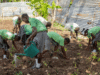
It's time to change our gaze on Haitian cities. The green spaces are not of the « decor ». These are public health infrastructures, as well as sewers or hospitals. With global warming, we have a unique chance to rethink our cities. Planting trees and bringing nature back to town is about protecting the most vulnerable people (children, pregnant women, the elderly...), making our streets much cooler in summer, and preparing a living future for everyone.
The future of our cities begins with one simple thing: planting a tree today.
Kyshna Ania-Eve Emmanuel
Pôle France-Europe, Haiti Sciences et Société (HaSci-So), Paris, France
kyshnaeemmanuel@gmail.com