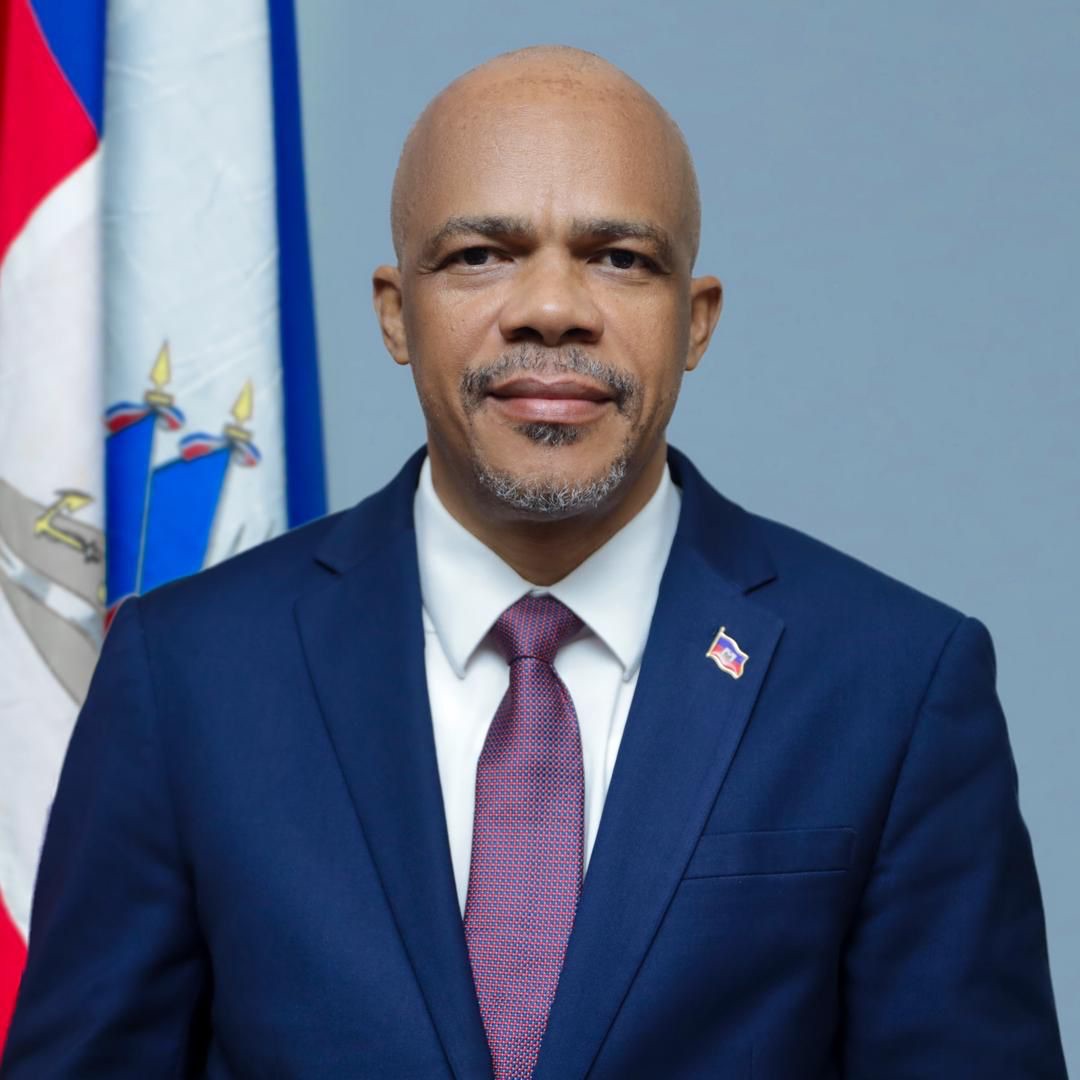


















He embodies a singular figure in the Haitian political landscape. Discreet but influential, cultured but pragmatic, Smith Augustine has today established himself as one of the pillars of the Transitional Presidential Council. This central role, forged by a solid diplomatic career and uncompromising commitment, is now worth as many admirers as critics. Portrait of a man whom some regard as a last bulwark to chaos, others as a threat to shoot down.
Born in Carrefour but with a long life experience in Ouanaminthe, close to the Dominican border which he will eventually watch as ambassador, Smith Augustine is first and foremost a man to know. He holds a doctorate in sociology, a master's degree in international fundamental rights law, and a degree in philosophy and social sciences. He combines critical reflection and in-depth knowledge of the region's social, political and geopolitical dynamics.
His academic training, acquired between Europe, Canada and the Dominican Republic, allows him very early to broaden his vision beyond the traditional Haitian divisions. From 2009 to 2014, he worked as a human rights officer at the United Nations, a founding experience that prepared him for the complexities of diplomatic dialogue and multilateral governance.
His appointment as Ambassador of Haiti to the Dominican Republic in 2020, under the presidency of Jovenel Moïse, marks a decisive step in his journey. In a context of tense relations between the two countries, Smith Augustine adopted a firm and constructive line. He works to restore an institutional channel of communication, while tirelessly defending the rights of Haitian migrants.
His interventions in regional diplomatic circles, particularly within the OAS, enable him to position Haiti in key discussions on security, migration, and human rights. He is perceived as a man of record, able to speak equally with regional chancelleries, without ever falling into hollow rhetoric or demagogic posture.
With the establishment of the Transitional Presidential Council in April 2024, Smith Augustine entered a new era of responsibility. Representative of the bloc "The Engaged for Development/RED – Historical Compromise", he quickly established himself as one of the structuring minds of the CPT, in a national context in the midst of a boil.
While some Council members seek power balances or partisan compromises, Augustine remains focused on the fundamental issues: security, diplomacy, justice, governance. Its ability to engage with foreign partners and international organizations strengthens its position as a key bridge in the transition.
But not everyone likes this rise in influence. For several months, Smith Augustine has been the target of multiple attacks: press campaigns, judicial challenges, diplomatic incidents... Nothing seems spared to anyone who is suspected, in words covered, of wanting to embody a form of political renewal.
The Anti-Corruption Unit (ULCC) recommended that it be prosecuted for acts related to the use of an irregular credit card issued by a former head of the National Credit Bank. Although no formal indictment was announced, the case was sufficient to temporarily undermine its reputation.
Yet, in February 2025, the Court of Appeal of Port-au-Prince overturned the lawsuits brought by Judge Benjamin Félismé against Smith Augustin and two of his colleagues Counselors-Presidents in this case. Indeed, the judicial verdict invalidated the summons issued in December 2024 against him, because of their presidential status. Thus, the Court held that this decision did not comply with the 1987 Constitution.
At the same time, some Dominican media exhumed an old controversy related to his visit to the embassy: the alleged organization of private evenings for Dominican journalists, where sex workers were reportedly present. The impugned charges, which are more of a low blow than a serious investigation.
At the beginning of August 2025, an event marked a turning point: Smith Augustin, it is said, was arrested and detained for almost four hours by the Dominican police in Santiago, after having entered the territory without prior diplomatic coordination. The incident, widely publicized in Haiti, feeds both bilateral tension and discourse against him. Strangely, neither the Dominican authorities nor the Dominican media reported the incident.
One day after the media scandal, the Presidency denounces rumours that do not resist the truthfulness of the facts. A strategy of an umpteenth political agitation, despite diplomatic apologies behind the scenes, to try to humiliate, neutralize or reverse it.
What bothers Smith Augustin is not only his ambition or his influence, it is his ability to think another Haiti: structured, sovereign, articulated with the rest of the world but rooted in his values.
In a context where the traditional figures of power grope or discredit each other, Augustine represents a serious, credible, demanding alternative. It makes no noise, does not saturate social networks, but works and that is enough to make it a target.
The case of Smith Augustine recalls a constant of Haitian political life: the integrity, cultured, strategic and independent profiles are often perceived as threats by the supporters of the « system « . But by attacking him, his opponents above all prove that he weighs in the balances, that he disturbs, that he counts.
It remains to be seen whether man, with his course and determination, will be able to turn this adversity into a political lever. What is certain is that history will remember that at a critical moment it was one of the few to carry a clear vision of the state and pay the price.
Isemelia Jean Baptiste