











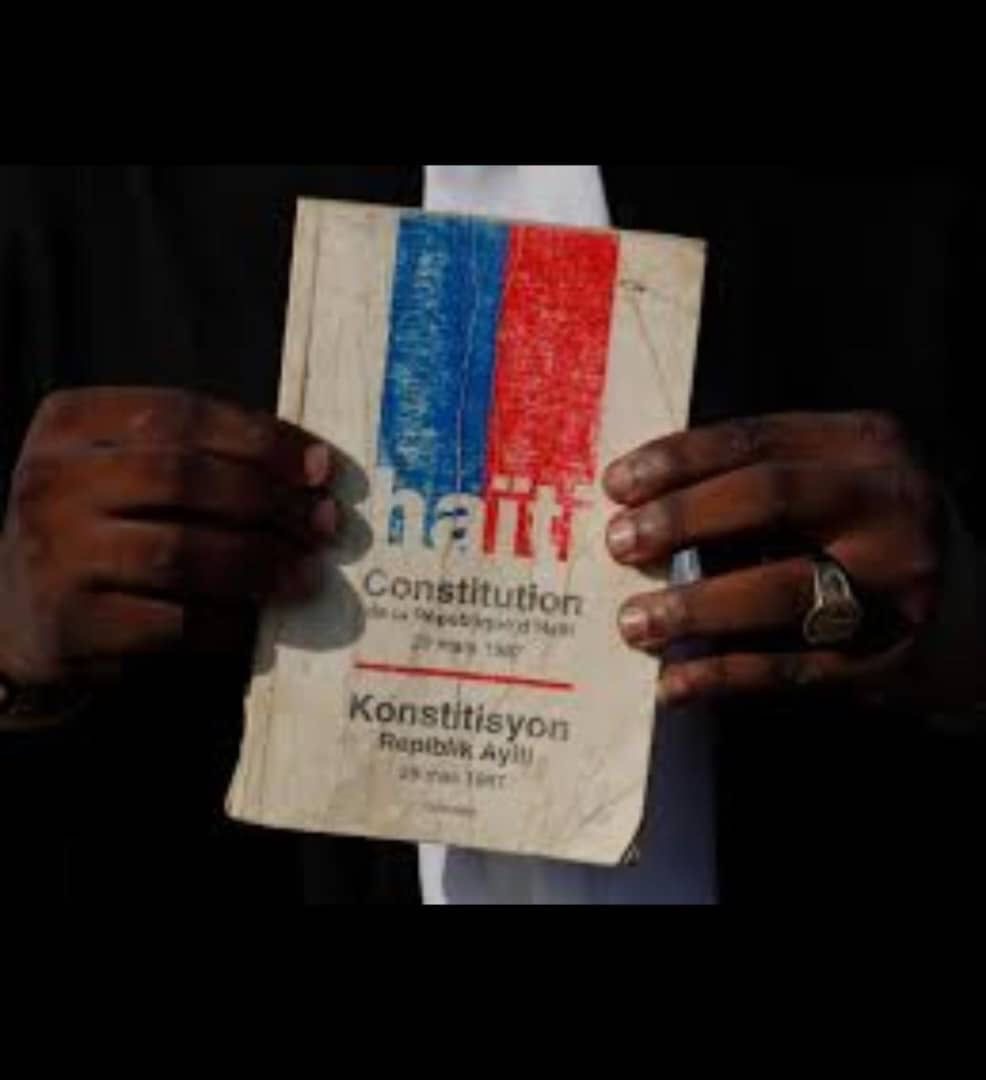
Port-au-Prince, 29 March 2026.- This 29 March 2026 marks the 39th anniversary of the 1987 Constitution, the founding text of the post-Duvalier era. While this «Mother Law» It must guarantee stability and democratic alternation, it is now at the heart of a tragic paradox. Between the sequels of the controversial amendment under the administration Martelly and the finding of institutional impotence recently admitted by the government, Haiti navigates in troubled waters, outside any defined legal framework
The foundation of a nation: More than a law, a survival contract
In the concert of nations, the Constitution is not just a collection of legal norms; It is the birth certificate of sovereignty and the guarantor of civil peace. In Haiti, the 1987 text has a quasi angelic charge: it was conceived as a bulwark against absolutism, a promise that «never again» A man would be above the law.
Diplomaticly, respect for the Constitution is the sine qua non for international recognition and bilateral cooperation. It is the mirror that we tend to the world to prove our political maturity. Yet this mirror is now broken.
The shadow of the Martelly amendment and the unfinished quest for reform
The infringement process accelerated during the presidency of Michel Martelly (2011-2016). The amendment of the Constitution, although introducing notable advances such as the 30% quota of women in the civil service, the recognition of multi-nationality for the diaspora or the creation of a Constitutional Council, was tainted by procedural doubts. The publication of divergent versions in the Official Journal Le Moniteur has created a legal blur whose country has never fully recovered.
Since then, attempts to reform have been unsuccessful. While some actors see the rigidity of the 1987 text as a hindrance to governance, others fear that a complete overhaul, in a climate of extreme polarisation, will serve only to strengthen partisan interests at the expense of the balance of power.
The finding of impotence: The confession of Patrick Chrispin
On 26 March, a wave of shock crossed the company, during the intervention of Patrick Chrispin, the current Secretary of State for Communication, on Magik 9. With an unusual franchise for a high dignitary, he admitted that the country is going through a period of unconstitutionality.
This admission is not trivial. It means that the executive evolves without the counter-power of Parliament, without a complete Court of Cassation and without a firm electoral calendar. In diplomacy, such a situation places Haiti in a grey zone, making international agreements precarious and the protection of citizens' rights random. We are no longer in the rule of the norm, but in the rule of the exception.
Bringing a Soul to the Republic
Celebrating 39 years of constitutionalism in such a context requires deep introspection. A Constitution is only valid by the will of those who apply it. If 29 March is not to be just a day of mourning for our institutions, it is imperative to find the way to national consensus.
The 1987 Constitution, despite its wrinkles and imperfections, remains the polar star that must guide us out of the abyss. Without a rapid return to constitutional order, it is the very essence of the Haitian state that risks evaporating, leaving room for permanent instability that neither force nor diplomacy will be able to contain.
W.A.