












By Quetya Aubin
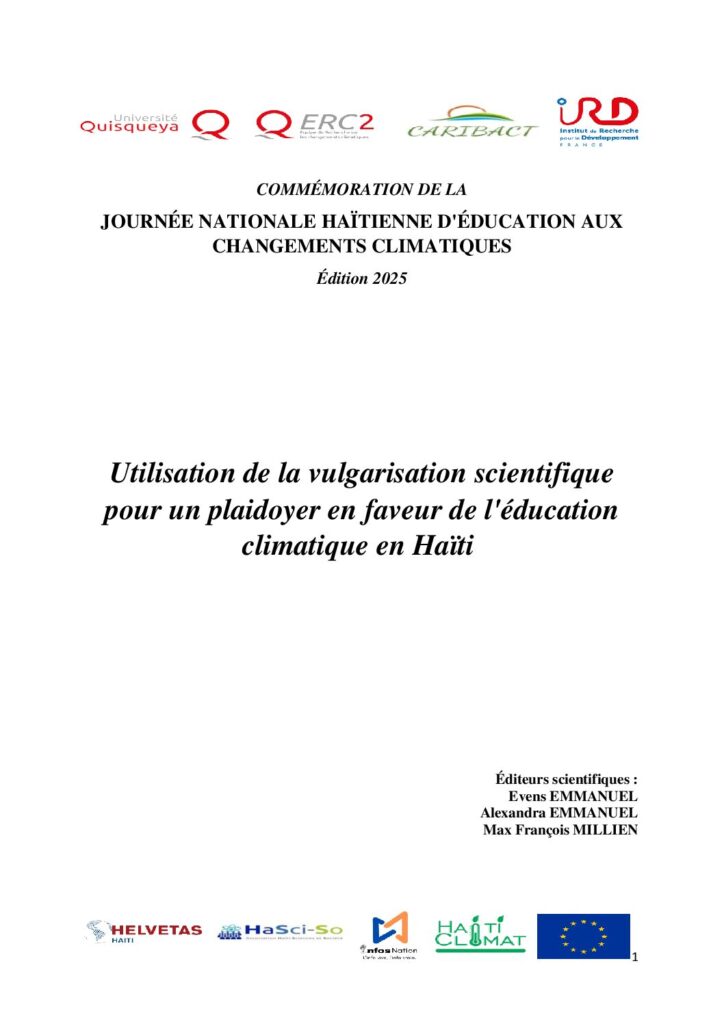
Just a few days after its official release on October 22, 2025, the collective work directed by Evens Emmanuel, Alexandra Emmanuel and Max François Millien arrives as a life-saving breath in the landscape of Haitian climate awareness. Published by Quisqueya University (UniQ) under the auspices of the Research Team on Climate Change (ERC2), this 83-page volume – legally deposited at the National Library of Haiti under the number 25-10-379 and ISBN 978-99994-0-408-2 – is not an arid academic treatise, but a vibrant, accessible and multifaceted advocacy.
Subtitled Synthesis of radio broadcasts and articles published in the print media, online media, scientific blog and UniQ News on Climate Change Education, it commemorates the 2025 edition of the Haitian National Day of Climate Change Education (JNHECC), celebrated on September 1. InfoNation is pleased to provide you with a report: A tribute to a work that transforms science into a collective weapon against the climate emergency.
A context of urgency and collective commitment
The book is part of a pivotal moment for Haiti, « Small Island Developing States » (PEID) where cyclones, floods and droughts are no longer « events » isolated, but daily realities amplified by global warming. The publishers – Evens Emmanuel (ERC2, GHERES, HaSci-So), Alexandra Emmanuel (ERC2, HaSci-So, GHERES) and Max François Millien (LAREZIA, UniQ) – thank a constellation of partner institutions: from IRD (France) to Helvetas Haiti, via the Delegation of the European Union, National Radio of Haiti, The Newlist, The National and of course Haiti Science and Society (HaSci-So), whose President has mandated for this reading.
This interdisciplinary collaboration – combining geoscience, environmental health, journalism and development – is the thread of the book, released under Creative Commons Attribution – No commercial use 4.0 International to promote free flow of ideas.
The core of the volume is the Turgeau Declaration, an incisive manifesto that calls for the institutionalization of JNHECC as a national pillar of resilience. Adopted at the 2025 edition, it insists on education as « rampart » against Haitian vulnerabilities: « Educate to survive, innovate to triumph », She says. It is the ethical foundation of a book that refuses scientific elitism to embrace popularization as a democratic tool.
A thematic mosaic: From science to human narrative
The summary reveals a fluid, almost journalistic structure: an inspiring preface, fifteen short chapters (2-4 pages each), a final synthesis and a general conclusion. The Preface (« Knowledge in Action: Pillar of Community Resilience ») In a Haiti where 80% of the population depends on rain-fed agriculture, climate education is not a luxury, but a luxury. « vital need ». Contributors – a dream team including Quetya Aubin (ERC2, HaSci-So), Esther Kimberly Bazile (Haïti Climat), Noclès Débréus (Le National), Nathan Jean-Pierre (Helvetas) and Jean Phares Jérôme (Le Nouvelliste) – alternate scientific analyses and field testimonies, making it all digest for a non-specialist audience.
The chapters are structured around three axes:
• Local and human narrative impacts: « Our fields, our future: The struggle of farmers on the island of Haiti against climate change » gives the voice to the peasants of the North, faced with eroded soils and erratic rains. Next « The National Park The Visit : An alarm cry for Haiti and beyond », which warns about the International CARIBACT (LMI-CARIBACT). « Lake Azuei tells 1000 years of Haitian climate » is a nugget: via sedimentary cores analysed by the URGeo, we reconstruct a millennium of climatic variations, linking pre-Columbian past to the current emergency. « Understanding the floods in Haiti » demystifies the Artibonite River floods with ERA-5 and CHIRPP models, highlighting the role of anarchic urbanization.
• Advocacy for national education: A salve of texts calls for JNHECC to be anchored in the official calendar. « 1 September, Haitian National Day of Climate Change Education: A Vital Necessity for Haiti » (argus for curriculum integration from primary school. « For a resilient Haiti: Education as a bulwark to climate change » and « Haiti wakes up to the climate » Proclaim for media as vectors: radio (Magik 9, National Radio), press (Le Nouvelliste, le National, InfosNation) and blogs (Breaves of UniQ). « Climate education, a national emergency »and « National Climate Change Education Day, an initiative to be consolidated » stress state support, with a nod to the National Plan for Risk and Disaster Management.
• Global dynamics and prospects: More technical chapters make the « climate giants » : « Great Antilles under the grip of extreme rain », « ENSO : A giant of the climate that shapes Haiti's destiny », « Multidecade Atlantic Oscillation » and « Pacific Decennial Oscillation (PDO) ». Based on NOAA and IPCC data, they explain how El Niño or the OMA modulate our monsoons without excessive jargon. « The political support of the Haitian state, an imperative for an effective fight against climate change-related diseases » climate to public health (zoonosis via LAREZIA), while « Scientific Diplomacy for Climate Resilience in Haiti» calls for a strong Haitian voice at the COP.
The Summary of the 2025 edition and the General Conclusion (« Educate for Survivor, Innovator for Triumph »More than a dozen media contributions (July-October 2025) have reached thousands of listeners and readers, amplifying Turgeau's echo towards a global « architecture of global resilience ».
Strengths and contributions: An exemplary popularization
What is striking is the balance: rigorous science (references to CNRS, IRD, FAO) in the service of a human narrative, with maps, implicit infographics and calls to action. The acronyms are a welcome guide for the neophyte, and the list of contributors humanizes the expertise. The Science Space and Information SocietyNation welcomes this scientific mediation: it closes the gap between laboratories (ERC2, URGéo, LMI-CARIBACT) and communities, aligned with the SDGs (Sustainable Development Goals) and the UNFCCC.
Minor criticism: a few thematic repetitions (the urgency of JNHECC) could be tightened, but this reinforces advocacy. Overall, it is a model for SHS (Human and Social Sciences) in a fragile context.
Conclusion: A call for action for all
Use of scientific outreach for advocacy for climate education in Haiti is not just a book; It's a catalyst. In a Haiti where the climate already strikes the most vulnerable – farmers, children, ecosystems like the Parc La Visite or Azuei – it reminds us that education is our best shield. To decision-makers (MDE, MARNDR), the media and to us citizens: let us read it, let us disseminate it, let us act on it. For a resilient Haiti, the JNHECC 2026 awaits us. Congratulations to the publishers and contributors – you sowed seeds of hope in the storm.
Quetya AUBIN
Haiti-Antilles Pole, Haiti Science and Society (Ha-Sci-So)
Team of Scientific Partners for Research Communication (E-PSi-CoRe)