


















Delmas, May 1, 2026.- A InfoNation survey reveals a worrying phenomenon: women are offered on Market Place as mere goods, with clearly displayed tariffs. Behind this reality, a structured system, extreme economic insecurity and youth delivered to itself. Between trivialization and "institutionalization" of prostitution, it is a whole society that is faltering.
In Haiti, Market Place is no longer just a sales space for goods and services. According to a survey conducted by the editor of InfoNation, the platform is now used to propose... women, for sexual purposes, with an organization that looks like a real business.
Offers are explicit, priced and structured. Behind these announcements, a network operating in Delmas, in particular, highlights a "availability" of women, with fixed prices, without negotiation. The operation is simple: a customer chooses, indicates a place, often a hotel and the service is delivered in less than an hour.
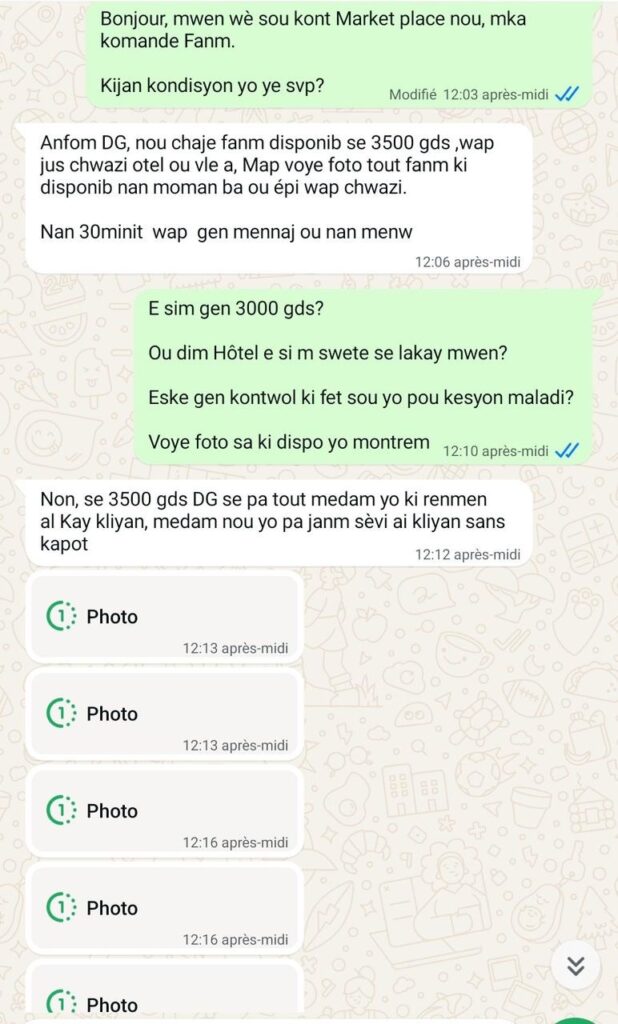
Beyond the shock, it is the mechanics that question. Contacted as part of the survey, one official stated that several women were permanently available. It refers to "protection measures", but no legal, health or institutional framework seems to govern this activity.
Even more disturbing, a catalogue of women is sent to potential clients. Carefully selected images, profiles put forward a cold commercial logic, where the body becomes produced.
Another disturbing element reinforces the scope of the phenomenon: this structure would also have a WhatsApp channel of more than a thousand subscribers. In this private area, offers would be disseminated more regularly and targeted, with direct interaction between administrators and potential customers. This digital presence, organized and monitored, suggests a well-installed system, which goes far beyond the framework of isolated advertisements to fit into a network logic.
The testimony that disturbs
The young woman selected and met in this survey alone embodies the social tragedy that feeds this system.
At the age of 26, living in Delmas, she had to drop out of school and share the difficult daily life of her family. Servant at a bar, she sometimes explains spending several months without being paid. Faced with this instability, she claims to have "no other choice" than to monetize her body to survive.
It also reveals an alarming reality: she believes that a large proportion of women working in night clubs are involved in this type of practice. A statement that is difficult to verify, but shows a phenomenon that goes beyond isolated cases.
On each benefit, she receives approximately 57% of the amount paid by the client. A form of "commission" that confirms the existence of an organised system, almost industrialized.
When prostitution changes its face
What shockes here is not only the existence of prostitution, an ancient reality in all societies, but its transformation.
Today it becomes:
- digitised (via online platforms),
- structured (with intermediaries and "catalogues"),
- commonplace (integrated into digital public spaces).
There is a form of "modernized prostitution", almost standardized, where the codes of traditional trade are applied to the human body.
Youth trapped by poverty
Derrière ce phénomène, une cause principale revient sans cesse : la précarité économique. Chômage massif, absence d’opportunités, salaires irréguliers, explosion du coût de la vie… autant de facteurs qui poussent des jeunes femmes et parfois des jeunes hommes vers des solutions extrêmes.
Dans un pays où survivre devient un combat quotidien, le corps devient parfois la dernière ressource.
Un silence inquiétant
Face à cette réalité, plusieurs questions se posent :
- Où sont les autorités ?
- Existe-t-il un contrôle des contenus diffusés sur ces plateformes ?
- Quelles politiques publiques pour protéger ces jeunes ?
L’absence de réponse claire laisse penser à une forme de tolérance implicite, voire d’impuissance.
Ce que révèle cette enquête dépasse le simple scandale. C’est le symptôme d’une société en crise, où la dignité humaine se négocie sous pression économique.
Si rien n’est fait, ce phénomène risque de s’étendre, de se normaliser davantage et de transformer durablement les rapports sociaux.
Car au fond, la vraie question est la suivante :
jusqu’où une société peut-elle aller quand survivre devient plus important que vivre ?
W.A.