


















By Quetya Aubin
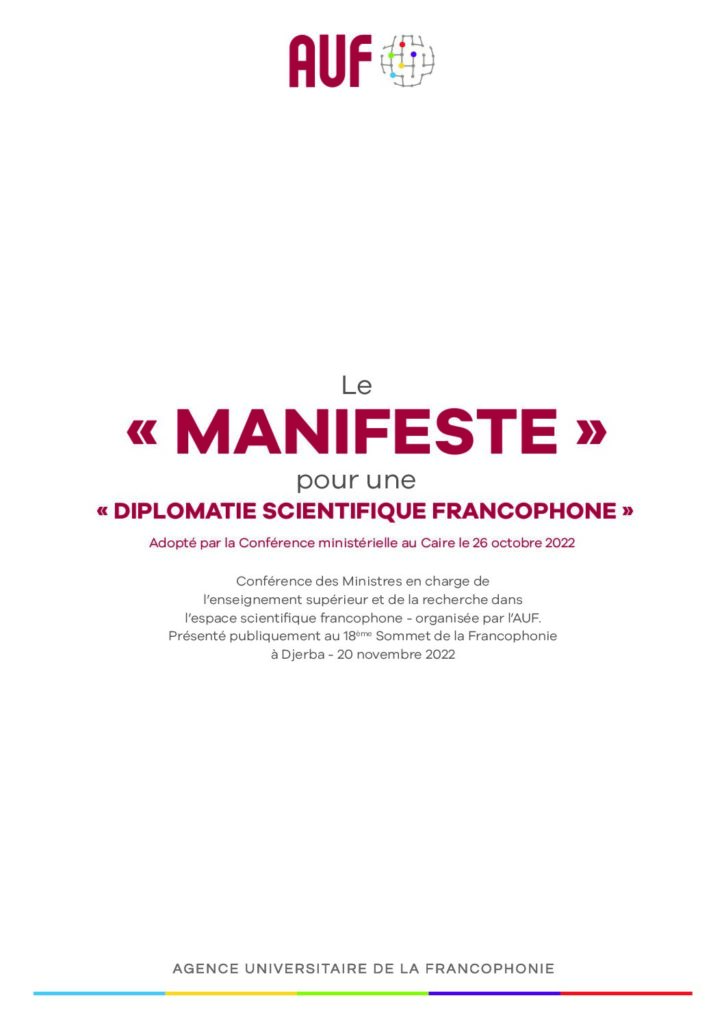
The Manifesto for a Francophone Scientific Diplomacy, adopted on 26 October 2022 at the Ministerial Conference in Cairo (Egypt) and presented at the 18th Summit of La Francophonie in Djerba (Tunisia) on 20 November 2022, represents a major milestone for the Agence universitaire de la Francophonie (AUF). Initiated during the first World Week of the Scientific Francophonie in Bucharest in September 2021, this unpublished document – co-signed or validated in principle by nearly 40 countries (including Haiti) – aims to transform the Francophonie into a space for proactive and supportive scientific cooperation. It responds to the urgency of global challenges (climate, pandemics, inequalities) by placing science at the heart of diplomacy, with AUF as a key operator.
This manifesto is not just a call for signatures: it proposes a concrete methodology to align public policy and scientific expertise, by valuing the Francophone space as an inclusive development lever.
Haiti, an active signatory through its engagement in the AUF and the Caribbean Bureau, sees it as a valuable tool to revive its higher education and research, weakened by the crisis. In this document, we deepen its structure, innovations, challenges and implications for Haiti, in connection with the recent election of Professor Evens Emmanuel to the AUF Board of Directors.
1. Structure and Main Content: An Operational Framework
The manifesto is structured into four main parts, structured around a forward-looking and pragmatic vision. Here is a comprehensive summary, based on the full text (published by the UFA in October 2022).
Preamble: Background and Issues
Challenges « global, multilateral and cross-border » (pandemics, climate, migration), the manifesto stresses the need for convergence « winners » between North and South. Francophone space – marked by a shared language, common values and historical ties – remains underexploited scientifically. Francophone scientific diplomacy (FSD) emerges as a « exchange and interface space » between politicians, scientists and civil society, promoting economic and cultural interdependence. Genesis: idea validated by 26 ministers in 2021, coordinated by AUF for a first edition « policy makers and supported by a global academic network ».
I. Concept Definition
The DSF is defined as the « creation of a space for exchange, cooperation, advocacy and active solidarity around the scientific Francophonie ». Two major objectives:
• Consolidation of scientific cooperation:
Mobilize all knowledge along the educational chain (primary to higher education and vocational training).
• Strengthening political-scientific ties: Promote dialogue for development through science, technology and innovation (STI).
II. Definition of Values
Six core values guide the FSD, rooted in the Francophone heritage:
- Respect for the diversity of cultures and languages.
- Equal opportunities for access to knowledge.
- Active solidarity for inclusive development.
- Gender equality.
- Human and scientific ethical considerations.
- Progress through openness, tolerance, democracy and dialogue.
These values underpin common advocacy (III.1) - integrating scientific expertise into public policies for innovative, inclusive and endogenous solutions.
III. Definition of Content
III.1. Need for a Common Advocacy
Scientific expertise must become a « proposal force » to enhance Francophone education systems, contribute to multilateral solutions and integrate local knowledge. The signatories (governments, AUF, OIF) commit themselves to supporting the SSF as an inclusive development framework.
III.2. Mobilizable means
Seven levers for effective FSD:
• Strengthening political-scientific networking: Articulate embassies, scientific attachés and interdisciplinary councils.
• Approach « standard-adapted » : Global convergence with local contextualization (ref. AUF White Paper, 2021).
• Forward-looking approach: Scientific watch via the International Academy of Scientific Francophonie (AUF).
• Promoting Francophone expertise: Census and shared databases to inform international discussions.
• Positive discrimination in solidarity: Support for countries in crisis and inclusion (gender equality, disadvantaged areas).
• Francophonie in plurilingual context: Cohabitation serene of languages, with multilingual translations.
• Results-oriented approach: Pragmatism against bureaucracy, focus on educational efficiency.
III.3. Shared priorities
Seven priority themes, evolving in consultation:
1. Institutionalizing skills mobility: Multilateral conventions (beyond ERASMUS+), reversal of South-North flows, new mutualised financing, fight against brain drain via niches of excellence and diaspora networking.
2. Valorizing Francophone publications: Increase number and visibility (international referral, support for journals).
3. Standardize the quality of institutions: Harmonize governance and quality assurance; labelisations adapted to boost attractiveness and resources.
4. Democratizing digital education: Hybrid models, virtual universities, collaborative platforms; access to digitized and shared resources.
5. Developing youth employability and entrepreneurship: Renewal of curricula, entrepreneurial training, job support structures, job-training referencing.
6. Professionalization of teaching staff and diplomas: Continuing training, certifications, teaching innovations (TICE, didactic).
7. Disseminating the culture of mediation and conflict management: Integrate into education to mitigate crises, promote dialogue and hope among youth.
IV. Governance for Operationalisation+
• Continuing the Annual Ministerial Conference: Exchange with the UFA as permanent secretariat; rotating presidency by host country.
• Eligibility: Ministers of Higher Education/Research (AUF Institutions), AUF Directorate, OIF.
• Co-built approach: AUF prepares agenda/records; commission of studies.
• Multi-year programming: Objectives, means, monitoring and evaluation for sustainability.
The manifesto concludes with a commitment by the signatories to promote its implementation, published in Cairo in October 2022.
2. Analysis: Innovations, Challenges and Opportunities Key Innovations: Unlike conventional bilateral approaches, the manifesto adopts a vision « multilateral solidarity », with iterative and forward-looking governance (AUF watch). It reverses paradigms: South-North flux, endogenous valorisation, hybrid numerical.
Politically incorrect but substantial: he assumes a « positive discrimination » for the South, criticising the anglocentrism of world rankings (e.g. QS Rankings) that marginalize La Francophonie (only 5% of global publications in French).
Challenges : Implementation depends on pooled funding (low in the South) and a rebalancing of flows (brain drain affects 70% of Haitian doctoral students trained abroad). The French-speaking bureaucracy risks curbing the »direction results ». To date (November 2025), 37 active signatories, but little concrete progress post-Djerba, despite initiatives like GEOACT in the Caribbean.
Opportunities for Haiti: In the midst of a crisis (insecurity, underfunding of the university), the manifesto offers a framework to revive the Doctoral College of Haiti (CDH – supported by AUF since 2011).
Priorities aligned: mobility (Firmin Antenor scholarships), publications (French-speaking versus dominant English), digital (PENDHA post-earthquake). With the presence of the Vice-President of Quisqueya University at the CA of AUF, Haiti can plead for a return of the Caribbean Bureau, an AUF expertise for ANERSRS (National Agency for Higher Education and Scientific Research) and a revision of the AUF-MAE agreement (2020).
Example: pooling funds for 20 annual doctoral fellowships via the CDH, integrating mediation for post-hurry resilience (such as Melissa, mentioned in Professor Evens Emmanuel's profession of faith).
3. Practical implications and call for action
For Haiti, a founding member of the AUF, the manifesto reinforces its pioneering role: the CDH – created in 2011 at the signing in 2022. He called for a review of the 2020 agreement (1 % of the PTF budget for research) and a state-UEH-UniQ-AUF meeting to relaunch the CDH.
In conclusion, this manifesto is not a relic: it is a « lever for the future » for a resilient Francophonie. Haiti, vulnerable but innovative (GEOACT at COP27), must appropriate it to transform challenges into opportunities. Contact the AUF (rectorat@auf.org) to join or deepen.
References
UF. (2022). The Manifesto is available! https://www.auf.org/news/actualites/le-manifeste-pour-une-diplomatie-scientifique-francophone-est-available/
UF. (2022). Climate change in the Caribbean... https://www.auf.org/news/actualites/change-climatic-in-la-caraibe-haiti-participe-la-cop27/
AUF. (2020). The Ministry of Foreign Affairs of Haiti.... https://www.auf.org/news/actualites/lauf-et-le-ministere-des-businesses-etrangeres-dhaiti-unite-to-strengthen-up-intelligence-superior-and-research-en-haiti/
Emmanuel, E. (2025). Profession of faith of Professor Evens EMMANUAL of the University Quisqueya, Candidate of the CA of the AUF – DRC. https://infosnation.com/profession-de-foi-du-professeur-evens-emmanuel-de-luniversite-quisqueya-candidat-au-ca-de-lauf-drc/
Quetya AUBIN
Haiti-Antilles Pole, Haiti Science and Society (Ha-Sci-So)
Team of Scientific Partners for Research Communication (E-PSi-CoRe)